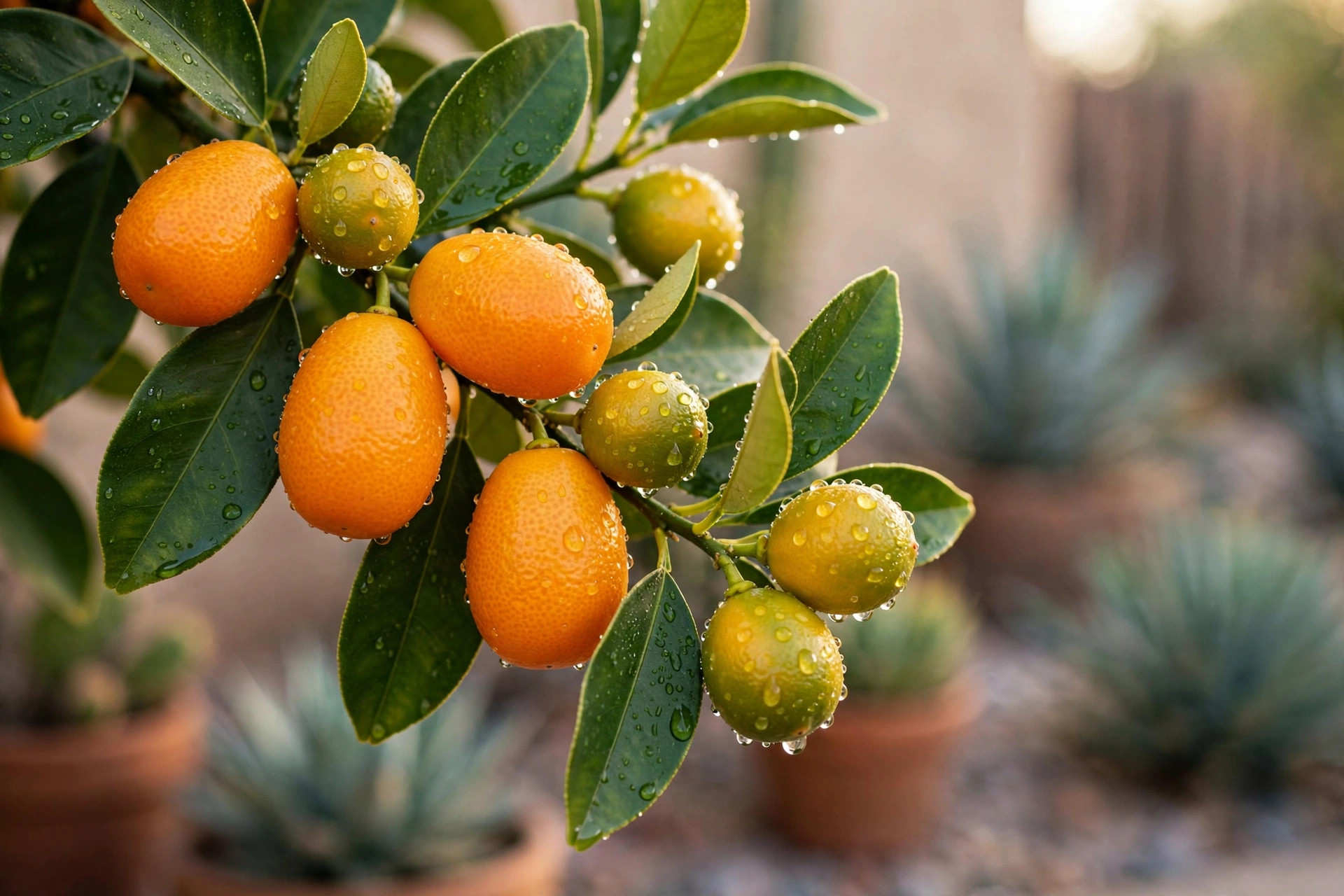
“'Just full of fruit every year.' Reliable producer.”
Background
Originated in Portugal; first catalogued in Massachusetts in 1843 and brought to California about 1849 by Portuguese immigrants, where it became the state's dominant lemon before Eureka. A vigorous, thorny, dense-canopied tree that tolerates hot-and-cold fluctuations and produces heavy, year-round crops in warm climates. One of the two standard commercial lemons worldwide (with Eureka), sold interchangeably in supermarkets.
Distinguishing traits
Medium-sized oblong fruit with a prominent blossom-end nipple, faint skin pitting, and a smoother, thinner rind than Eureka; no stem-end neck. Very acidic, juicy pulp with few or no seeds. Fruit grows inside the dense canopy, yielding smoother, less blemished fruit. Bears two main crops per year (vs. Eureka's near-continuous bearing). Thorny branches.
Desert care — zone 9b
- Chill hours
- Minimal.
- Cold hardiness
- ~28-30°F; more cold-tolerant than Eureka per some accounts but still needs frost protection; fruit is not cold-hardy.
- Heat tolerance
- Tolerates desert heat and temperature fluctuations well; reliable producer in the Salt River Valley with irrigation.
- Water
- Year-round producer needs year-round water: deep watering 1-2x/week summer; do not let fruit-bearing trees drought-stress.
- Soil
- Well-drained, pH 6.0-7.5; tolerant of varied soils.
- Sun exposure
- Full sun; trunk whitewash on young trees.