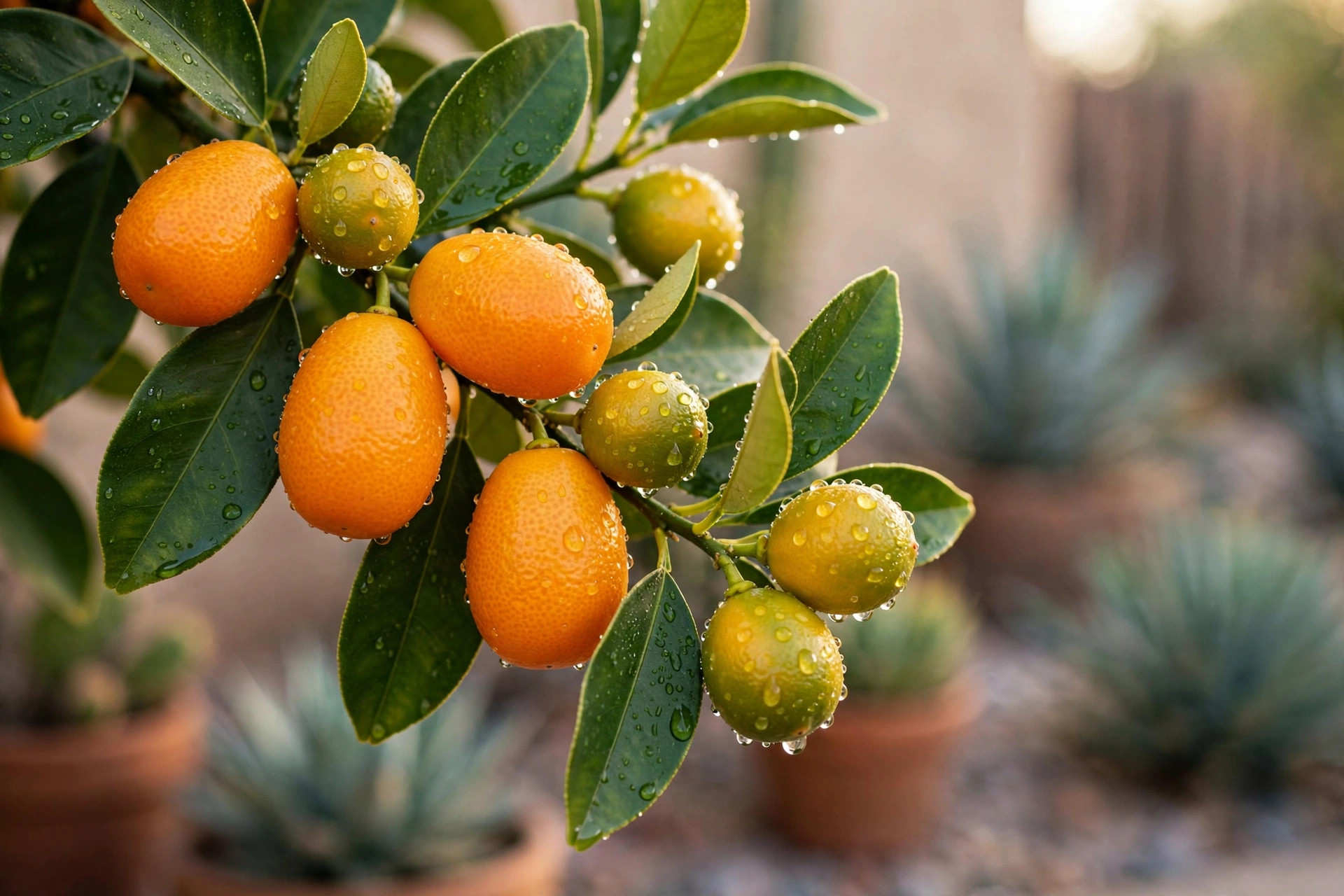
“Cocktail tree — one side Key lime, other side rootstock/lemon. Mature tree.”
Background
The Key (Mexican/West Indian) lime is a natural hybrid (likely citron × Philippine wild lime, C. micrantha) native to Southeast Asia; carried to the Caribbean by Columbus and naturalized in the Florida Keys, whence the name 'Key' (OED first use 1905). Henry Perrine introduced it to Florida; commercial Florida groves were wiped out by the 1926 hurricane, after which Persian limes took over. UA Extension lists 'Mexican Lime (Key Lime)' as ripening in September in Arizona. The UA arboretum traces the lime's path from Southeast Asia via Arab traders and Crusaders to the Americas, where it was commercialized in Florida.
Distinguishing traits
Small, shrubby, thorny, irregular tree (6-13 ft), dense glossy foliage, fragrant white-to-lavender-tinged flowers borne much of the year. Fruit small, thin-skinned, harvested green, ripening to yellow; intensely aromatic, very acidic juice with 10-15 seeds. The classic Key lime pie lime. Least cold-hardy of all citrus. The UA arboretum describes Key lime as a small vigorous tree or large shrub of 6-13 feet with aromatic glossy leaves and fragrant white flowers.
Desert care — zone 9b
- Chill hours
- Minimal/none.
- Cold hardiness
- Most frost-sensitive citrus; damage below ~30-32°F, killed near ~26-28°F. Must have the warmest microclimate or winter protection in 85142. The UA arboretum calls it the most frost-sensitive citrus: leaf and flower damage at 30-32°F, wood damage or death below 29°F.
- Heat tolerance
- Thrives in hot conditions; loves desert summer heat with adequate water.
- Water
- Consistent moisture; deep watering 1-2x/week summer; never drought-stress while fruiting. The UA arboretum rates water use as high but warns overwatering causes fungal decline; it is very drought tolerant once established.
- Soil
- Well-drained, pH 6.0-7.5; tolerates sandy/rocky soils.
- Sun exposure
- Full sun.